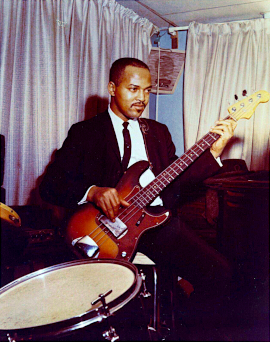
As the uncredited house bassist for Motown's Funk Brothers, he played on scores of No. 1 hits and defined melodic electric bass; Bass Player magazine and countless pros call him the most influential bassist in history.
The low end decides everything.

As the uncredited house bassist for Motown's Funk Brothers, he played on scores of No. 1 hits and defined melodic electric bass; Bass Player magazine and countless pros call him the most influential bassist in history.
His self-titled 1976 debut and work with Weather Report redefined the fretless electric bass as a lead voice; he is routinely named among the greatest bassists of all time and was inducted into the Grammy Hall of Fame.
His inventive, counter-melodic basslines on Beatles records made the instrument a lead voice in pop, and he remains one of the best-selling and most influential musicians ever.

He pioneered treble-heavy, lead-style bass playing heard on 'My Generation,' and topped Rolling Stone's 2011 readers' poll of the greatest bassists of all time.
His aggressive slap-and-pop style powered Red Hot Chili Peppers hits like 'Give It Away,' earning the band a Rock and Roll Hall of Fame induction in 2012.
He handles complex bass, synths, and lead vocals simultaneously in Rush, and is regularly ranked among the greatest and most technically accomplished rock bassists.
His fluid, groove-driven basslines and multi-instrumental arrangements anchored Led Zeppelin, one of the best-selling bands in history; he was inducted into the Rock and Roll Hall of Fame in 1995.
He shaped funk bass with James Brown and Parliament-Funkadelic, and his 'space bass' grooves earned him a 1997 Rock and Roll Hall of Fame induction with Parliament-Funkadelic.

With Sly and the Family Stone he pioneered the slap-and-pop technique that became foundational to funk, and he was inducted into the Rock and Roll Hall of Fame in 1993.
As a first-call Los Angeles session bassist she played on thousands of recordings, from 'These Boots Are Made for Walkin'' to countless film and TV themes, making her one of the most-recorded bassists ever.

His distorted, melodic bass and the solo '(Anesthesia)—Pulling Teeth' brought new prominence to metal bass before his death in 1986; he was inducted with Metallica into the Rock Hall in 2009.
His slap, tapping, and strumming techniques front Primus and make him one of the most technically distinctive bassists in rock, frequently topping reader polls.
His trebly, aggressive Rickenbacker tone helped define progressive rock across Yes's catalog, and he was inducted into the Rock and Roll Hall of Fame in 2017.
His reggae-inflected basslines and vocals fronted The Police, though he's celebrated more as a songwriter and singer than as a technical bass innovator.
He wrote most of Black Sabbath's lyrics and laid down doom-defining basslines that shaped heavy metal, earning a 2006 Rock and Roll Hall of Fame induction.
His fast, galloping fingerstyle drives Iron Maiden and he founded and leads the band, but his role is stylistically narrow compared with the innovators above.
A hugely successful frontman and marketer with KISS, his straightforward root-note bass playing is valued far more for spectacle than musicianship.
He's Motley Crue's chief songwriter and image architect, but his bass work is basic and often criticized as secondary to the band's theatrics.

The Sex Pistols bassist was famously unable to play competently; his bass was reportedly turned down or unplugged in the studio and on stage, making him more symbol than musician.
◆ Ranked on Tier Deck · browse all 296 lists · Privacy · Terms