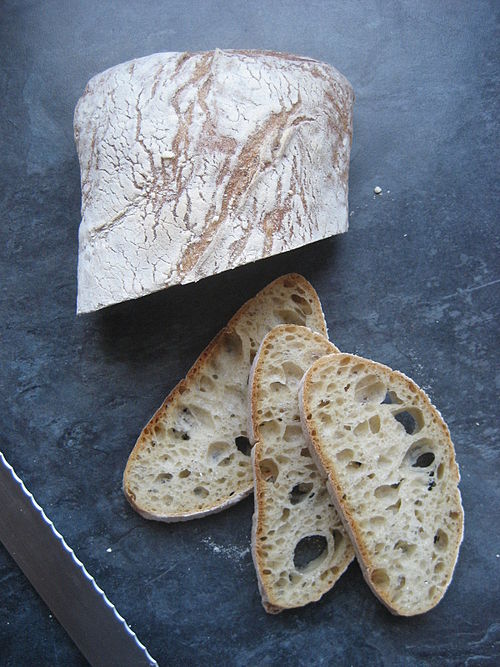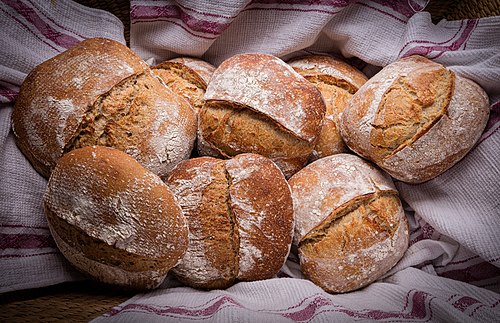
Leavened by a naturally cultivated starter of wild yeast and lactobacilli rather than commercial yeast, giving its signature tang, open crumb, and blistered crust. The technique predates commercial baker's yeast by millennia.
The definitive loaf ladder, from crust royalty to plastic-bag shame.
Leavened by a naturally cultivated starter of wild yeast and lactobacilli rather than commercial yeast, giving its signature tang, open crumb, and blistered crust. The technique predates commercial baker's yeast by millennia.
A long, thin loaf of French bread whose crackling crust and airy interior are so culturally central that the artisanal know-how and culture of baguette bread earned UNESCO Intangible Cultural Heritage status in 2022. Endless versatility from butter to sandwiches.
An Italian flatbread dimpled and drenched in olive oil, salt, and herbs before baking, yielding a crisp bottom and tender, oil-rich crumb. Ligurian focaccia is one of Italy's oldest breads.
A leavened flatbread traditionally slapped onto the searing wall of a clay tandoor oven, producing charred blisters and a chewy, pliable interior perfect for scooping curries. A staple across South and Central Asia.
Invented in Italy in 1982 by baker Arnaldo Cavallari as a rustic answer to the French baguette, its very wet, high-hydration dough creates a signature open, hole-riddled crumb. Its name literally means slipper for its flat shape.
A dense, chewy ring uniquely boiled before baking, a step that sets its glossy crust and tight crumb apart from every other bread. Rooted in the Jewish communities of Poland and now a New York institution.
A French enriched bread with a high egg and butter content that gives it a rich, tender, almost cake-like crumb and golden sheen. Its indulgence bridges the gap between bread and pastry.
A braided egg-enriched bread traditionally eaten on Jewish Sabbath and holidays, its glossy crust achieved with an egg wash and its crumb soft and slightly sweet. Also makes exceptional French toast.
Made partly or wholly from rye flour, it is denser and darker than wheat bread with a distinctive earthy tang, and is a dietary staple across Northern and Eastern Europe. Rye's lower gluten yields a tighter crumb.
A round leavened flatbread that puffs dramatically in a hot oven as steam forms an internal pocket, ideal for stuffing with falafel or shawarma. A cornerstone of Middle Eastern and Mediterranean cuisine.
A quick bread leavened with baking powder and built on cornmeal, giving a crumbly, slightly sweet or savory texture. A defining bread of the American South with Native American roots.
A dough knot dipped in an alkaline lye or soda bath before baking, which produces its deep-brown skin and unmistakable savory crust. A German and Alsatian tradition dating to the Middle Ages.
A tall, domed Italian sweet bread from Milan studded with candied fruit and raisins, made with a slow natural-yeast rise over many hours. Beloved at Christmas but divisive thanks to the fruit.
A moist quick bread that turns overripe bananas into a sweet, dense loaf leavened by baking soda rather than yeast. It surged into a global baking phenomenon during the 2020 lockdowns.
A thin unleavened flatbread of corn or wheat that is the foundation of Mexican cuisine, from tacos to quesadillas. Endlessly useful but plain on its own, it lives or dies by its filling.
Made with flour that retains the bran and germ, it delivers more fiber and nutrients than white bread but a denser, less airy crumb. Virtuous and hearty rather than exciting.
Made from refined flour with the bran and germ removed, sacrificing fiber and flavor for a soft, uniform crumb. Functional for sandwiches but nutritionally and texturally the baseline.
A mass-produced brand of sliced white bread that debuted on May 21, 1921, marketed as squishy, spongy, and long-shelf-life, it became the symbol of industrial over-processing. Compresses to a pea with one squeeze.
◆ Ranked on Tier Deck · browse all 296 lists · Privacy · Terms