
Orion
The Hunter
Home to the sky's most famous three-star belt plus supergiants Betelgeuse and Rigel, and visible from nearly everywhere on Earth. Contains the Orion Nebula (M42), a naked-eye stellar nursery.
88 patterns in the sky. Only one is Orion.
Home to the sky's most famous three-star belt plus supergiants Betelgeuse and Rigel, and visible from nearly everywhere on Earth. Contains the Orion Nebula (M42), a naked-eye stellar nursery.
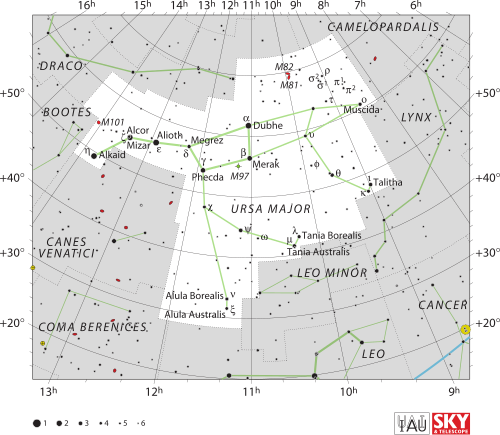
Contains the Big Dipper, one of the most recognized asterisms on Earth, whose pointer stars Dubhe and Merak line up straight to Polaris. Third-largest of all 88 constellations.

The smallest constellation yet the defining landmark of the southern sky, appearing on the flags of Australia, New Zealand and Brazil. Its long axis points toward the south celestial pole.

One of the few constellations that genuinely looks like its namesake, curling from the red supergiant Antares down to a hooked stinger. A zodiac constellation packed with bright stars near the Milky Way's core.

The backwards-question-mark 'Sickle' clearly traces a lion's head, anchored by first-magnitude Regulus. A prominent zodiac constellation and the radiant of the Leonid meteor shower.

The Northern Cross asterism flies right down the Milky Way, tipped by the brilliant star Deneb, a vertex of the Summer Triangle. Hosts Cygnus X-1, the first widely accepted black hole candidate.

Its unmistakable W (or M) shape sits opposite the Big Dipper across Polaris and never sets for northern observers. A reliable circumpolar signpost for finding the pole star.

Marked by orange Aldebaran and containing two naked-eye star clusters, the Pleiades and the Hyades. Its horn tip hosts the Crab Nebula, remnant of a supernova recorded in 1054 AD.

Better known for its 'Teapot' asterism, which points toward the galactic center where the Milky Way is thickest. A zodiac constellation dense with nebulae and star clusters.

Contains Sirius, the brightest star in the entire night sky at magnitude -1.46. Orion's faithful hunting dog, easily found by following the belt down-left.

The twin stars Castor and Pollux head two near-parallel lines of stars, an easy zodiac pattern. Radiant of the Geminids, one of the year's best meteor showers.

Small but anchored by Vega, the fifth-brightest star and a corner of the Summer Triangle. Home to the Ring Nebula, a favorite small-telescope target.
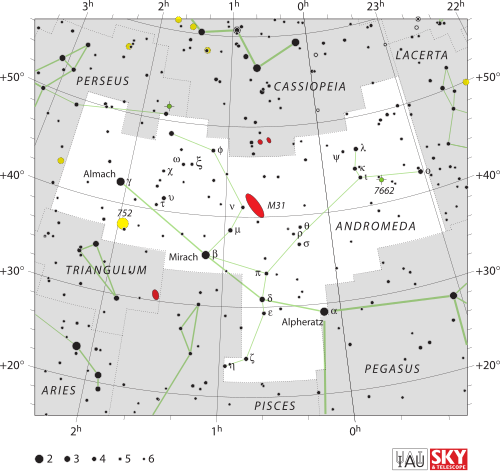
Points the way to the Andromeda Galaxy (M31), the most distant object easily visible to the naked eye at 2.5 million light-years. Chained to the neighboring Great Square of Pegasus.

Led by bright Altair, the third vertex completing the Summer Triangle with Vega and Deneb. A solid Milky Way constellation, though it plays second fiddle to its brighter neighbors.

A long, winding chain of mostly faint stars snaking between the two Dippers. Its star Thuban was the north pole star around 3000 BC due to precession.
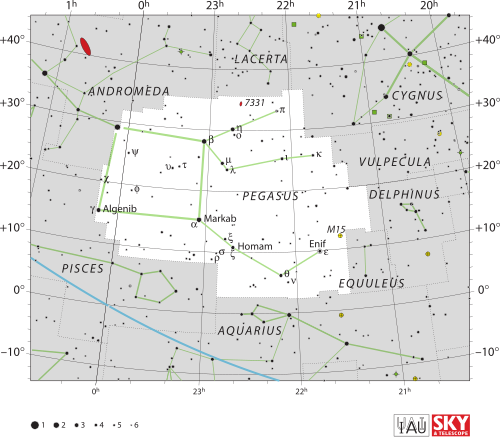
The large 'Great Square' is easy to spot but hollow, with few bright stars inside its borders. Still a useful autumn signpost for star-hopping.

A famous zodiac name that underwhelms in reality, essentially a short crooked line of three modest stars. Once marked the vernal equinox, now shifted by precession.

The faintest of the twelve zodiac constellations, its brightest star Al Tarf reaching only magnitude 3.5. Its one saving grace is the Beehive Cluster (M44), a smudge to the naked eye.

A dim, modern filler constellation introduced by Hevelius in the 1680s, with no star brighter than magnitude 4.5. Sits in a barren patch of sky south of Leo with nothing to catch the eye.

The single faintest constellation in the sky, the only one with no star above magnitude 5.0. A near-invisible southern square that even seasoned observers struggle to trace.
◆ Ranked on Tier Deck · browse all 296 lists · Privacy · Terms