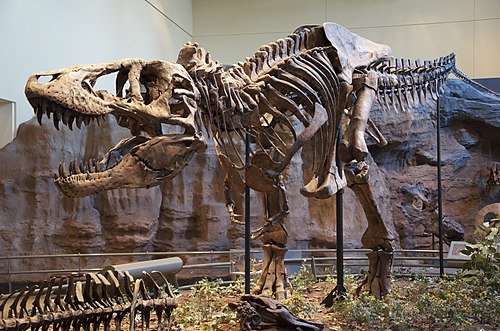
Tyrannosaurus
Late Cretaceous · Apex predator
Bite force estimated at over 35,000 newtons, the strongest of any known land animal, capable of pulverizing bone. It remains the most-studied and most-recognized dinosaur ever found.
Every terrible lizard was not created equal.
Bite force estimated at over 35,000 newtons, the strongest of any known land animal, capable of pulverizing bone. It remains the most-studied and most-recognized dinosaur ever found.

Its three-horned skull with a massive bony frill is among the largest of any land animal, up to 2.5 meters long. One of the last non-avian dinosaurs to exist before the extinction.

A turkey-sized feathered dromaeosaur with a killing sickle-claw, confirmed by quill knobs preserved on a fossil forearm. Culturally massive despite being far smaller than its movie portrayal.
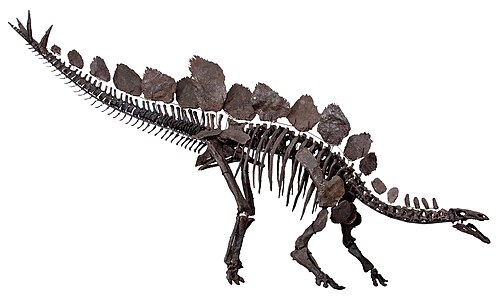
Its iconic back plates and spiked 'thagomizer' tail make it instantly recognizable, and its brain was famously tiny relative to its body. A defining Jurassic herbivore.

Likely the longest known predatory dinosaur at up to 15 meters, and the strongest evidence yet for a semiaquatic, fish-hunting lifestyle with a paddle-like tail described in 2020. Original fossils were destroyed in WWII.

Its forelimbs were longer than its hindlimbs, giving it a giraffe-like posture to browse treetops over 12 meters high. A textbook example of sauropod gigantism.
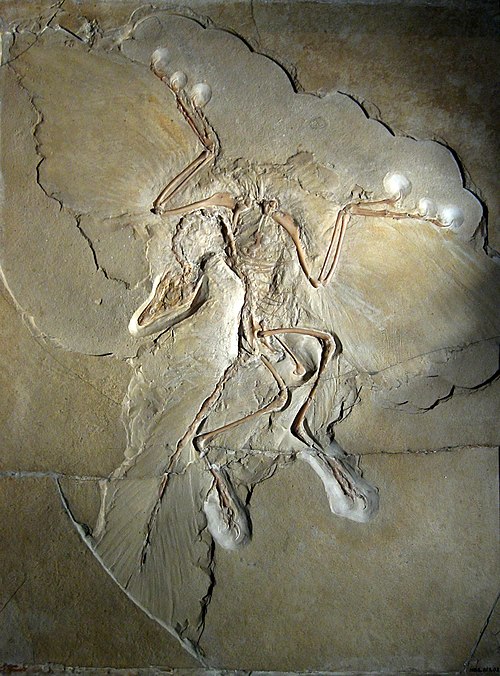
A transitional fossil linking dinosaurs to birds, with feathers and wings but also teeth and a bony tail. Its 1861 discovery became a keystone of evolutionary evidence.

Covered in bony osteoderms and wielding a massive tail club that could shatter bone, it was the living tank of the Cretaceous. Its low, wide build made it nearly impossible to flip.

One of the longest dinosaurs at up to 26 meters, with a whip-like tail and a neck held roughly horizontal. Cast skeletons were gifted to museums worldwide, making it globally familiar.

The dominant large predator of Late Jurassic North America, using its serrated teeth and hatchet-like jaw motion to attack big prey. Known from abundant, well-preserved remains.

Its long, hollow head crest likely functioned as a resonating chamber to produce low-frequency calls. A standout among the duck-billed hadrosaurs.
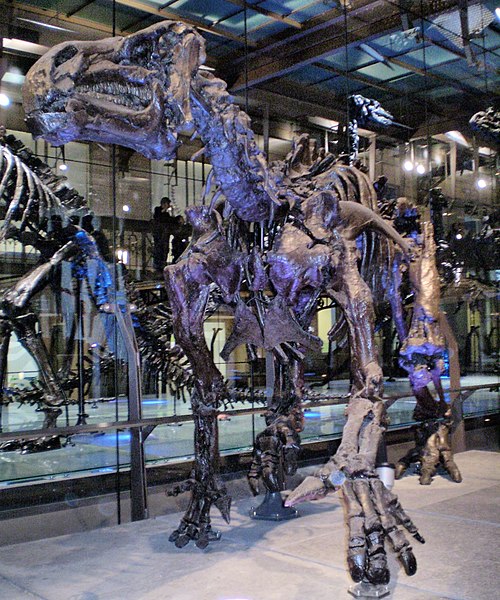
One of the three founding genera Richard Owen used to define Dinosauria in 1842, and only the second dinosaur ever formally named. Its distinctive conical thumb spike was originally misplaced on its nose.

Famous for its thick 25-centimeter skull dome, though whether it was used for head-butting or display remains debated. Known mostly from skulls, with little else preserved.

For decades one of the smallest known dinosaurs, roughly the size of a turkey, showing dinosaurs weren't all giants. A fast, agile insect-and-lizard hunter.

Named 'egg thief' after being found atop a nest, it was later vindicated when the eggs proved to be its own that it was brooding. A cautionary tale in paleontology.

A real crested early predator around 6 meters long, but pop culture saddled it with a frill and venom spitting that have no fossil basis. Misremembered more than it's understood.

Long the poster child of dinosaurs, it was ruled a duplicate of Apatosaurus for over a century before a 2015 study tentatively revived it. A monument to the 19th-century 'Bone Wars' mess.

Widely argued to be a juvenile Tyrannosaurus rather than a distinct genus, making its validity one of paleontology's longest-running disputes. A taxonomic headache more than an animal.
◆ Ranked on Tier Deck · browse all 296 lists · Privacy · Terms