
Shinkansen
The original bullet train
The world's first high-speed rail, opened for the 1964 Tokyo Olympics, with a legendary near-perfect safety record over billions of passengers and speeds up to 320 km/h.
From the bullet train that started it all to the record-breakers still on test tracks.
The world's first high-speed rail, opened for the 1964 Tokyo Olympics, with a legendary near-perfect safety record over billions of passengers and speeds up to 320 km/h.

A modified TGV set the world record for a conventional train at 574.8 km/h in 2007; in service it runs at up to 320 km/h across France's vast high-speed network.

China's flagship CR400 Fuxing runs at 350 km/h in commercial service, the fastest scheduled speed on Earth, across the world's largest high-speed network of over 45,000 km.

The only high-speed maglev in commercial service, reaching 431 km/h on its airport run since 2004, floating on magnets with no wheels touching the track.

This Japanese maglev set the absolute rail land-speed record of 603 km/h in 2015 and is built for the Chūō Shinkansen, targeting 500 km/h in commercial service.

Deutsche Bahn's high-speed service since 1991, running at up to 300 km/h and forming a cross-border backbone linking Germany with its neighbors.
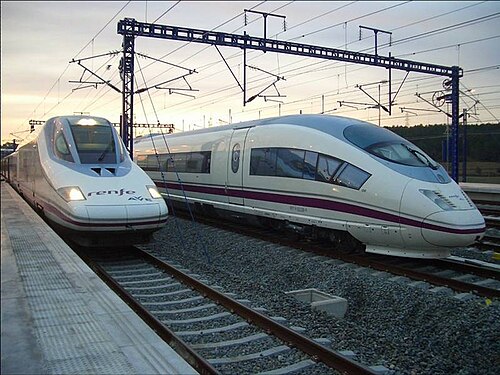
Spain's high-speed network, launched in 1992, is the longest in Europe and second-longest in the world, with trains cruising at up to 310 km/h.

Operating through the Channel Tunnel since 1994, it links London to Paris and Brussels at up to 300 km/h, transforming travel between Britain and the continent.

Korea Train Express, launched in 2004 using TGV-derived technology, runs at up to 305 km/h and carries the bulk of South Korea's intercity rail traffic.

Trenitalia's flagship runs at 300 km/h down the spine of Italy and competes head-to-head with private rival Italo on the country's high-speed lines.

Opened in 2007 using Japanese Shinkansen technology, it links Taipei to Kaohsiung at up to 300 km/h, slashing the west-coast journey to around 90 minutes.

The multinational service connecting Paris, Brussels, Amsterdam and Cologne at up to 300 km/h, a benchmark of international high-speed travel now folded into Eurostar.

The German-developed maglev system that powers the Shanghai line, tested at 501 km/h on its Emsland track, an engineering milestone despite never opening in Germany.

Saudi Arabia's 300 km/h line, opened in 2018, connects the holy cities of Mecca and Medina and is the fastest railway in the Middle East.

The sole US high-speed service, running the Northeast Corridor since 2000 and hitting 240 km/h only on limited stretches, held back by aging shared track.

A widely adopted tilting-train family that leans into curves to run faster on existing lines, deployed across Britain, Italy and much of Europe.

The Spanish manufacturer's distinctive lightweight, low-slung articulated trains enable high speeds and gauge-changing, exported across Europe, the US and beyond.

A South Korean experimental trainset that reached 421.4 km/h in 2013, making Korea the fourth nation to develop a train topping 420 km/h, though it never entered service.

Alstom's next-generation tilting trainsets built to replace the original Acela fleet, designed for 257 km/h on the US Northeast Corridor.

Siemens' high-speed platform underlying Germany's ICE 3 and exported worldwide; a Spanish Velaro set a wheeled record of 403.7 km/h in 2006.
◆ Ranked on Tier Deck · browse all 296 lists · Privacy · Terms