
Titan
The other Earth-like world
Saturn's largest moon is the only one with a dense atmosphere and stable surface liquids — lakes and rivers of methane — and a prime target for prebiotic chemistry.
Ocean worlds, volcanic hellscapes, and one very familiar face.
Saturn's largest moon is the only one with a dense atmosphere and stable surface liquids — lakes and rivers of methane — and a prime target for prebiotic chemistry.

Beneath its cracked ice shell lies a global saltwater ocean holding perhaps twice Earth's water, making it NASA's leading candidate to host life.

Cassini flew through plumes erupting from its south pole, sampling a subsurface ocean laced with organics and hydrogen — chemistry that could feed microbes.
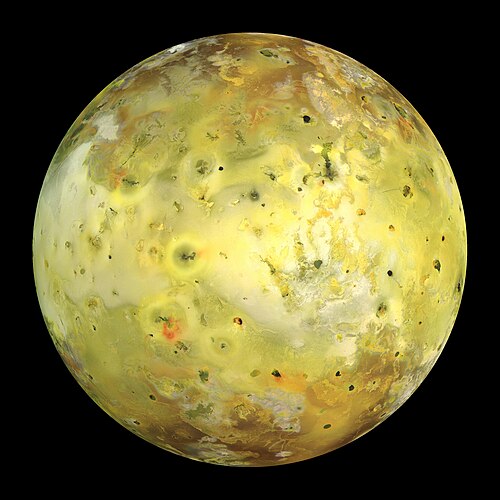
Jupiter's tidal grip makes Io the most geologically active object in the Solar System, with hundreds of active volcanoes and lava lakes.

The only world beyond Earth humans have walked on; returned samples revealed the giant-impact origin theory and it drives our tides and stabilizes Earth's axis.

Bigger than the planet Mercury and the only moon with its own magnetic field, likely hiding a saltwater ocean beneath its icy crust.

Neptune's largest moon orbits retrograde — evidence it was a captured Kuiper Belt object — and Voyager 2 spotted active nitrogen geysers on its frozen surface.

One of the most heavily cratered surfaces in the Solar System, this ancient Galilean moon may also conceal a subsurface ocean.

Saturn's oddest satellite has one hemisphere far darker than the other and a bizarre equatorial ridge that gives it a walnut-like shape.

Dominated by the enormous Herschel crater that makes it resemble the Death Star, Mimas surprisingly appears to harbor a young internal ocean.

So large relative to Pluto that the pair orbit a shared point in space; New Horizons revealed its vast canyon system and reddish polar cap.

This small Uranian moon has one of the most jumbled surfaces known, including Verona Rupes — a cliff up to 20 km high, among the tallest in the system.

Orbits so close to Mars that tidal forces are pulling it inward; it is expected to break apart or crash within tens of millions of years.

An icy, heavily cratered moon that briefly raised the intriguing possibility of a faint ring — the first ever suggested around a moon.

Its bright 'wispy terrain' turned out to be networks of ice cliffs, and it may host a modest subsurface ocean of its own.
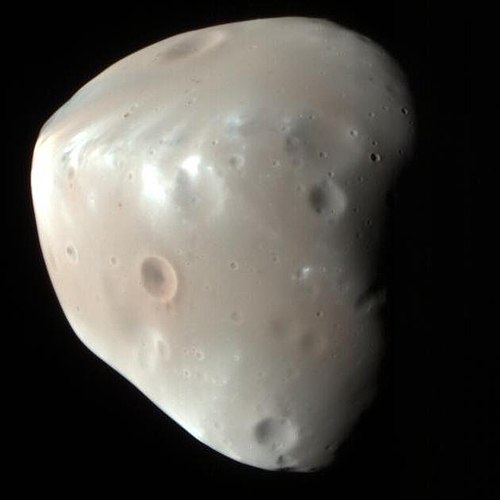
The smaller, smoother, and more distant of Mars's two moons, a lumpy 12 km body likely captured from the asteroid belt.

Uranus's biggest satellite, marked by huge canyons and fault valleys hinting at past geological expansion of its icy crust.

A dark, ancient, crater-scarred moon of Uranus with mysterious reddish material on some crater floors.

An irregular inner moon so red it may be the reddest object in the Solar System, and surprisingly less dense than water.

A chaotically rotating moon of Saturn with a bizarre sponge-like appearance, but small and comparatively little studied.

A distant, retrograde outer moon of Saturn likely captured from the outer Solar System — scientifically minor beyond its exotic origin.
Has one of the most eccentric orbits of any moon, but it is small, faint, and among the least explored of the notable satellites.
◆ Ranked on Tier Deck · browse all 296 lists · Privacy · Terms