
United States
Stars and Stripes
Fifty white stars for the states and thirteen stripes for the original colonies. Globally recognizable, though the canton of stars is busier than pure minimalist design allows.
Some nations nailed it. Others put a rifle on it.
Fifty white stars for the states and thirteen stripes for the original colonies. Globally recognizable, though the canton of stars is busier than pure minimalist design allows.

A single crimson disc centered on white, the Hinomaru is about as minimal as a flag can get while remaining instantly identifiable worldwide. Its sun-disc design traces back centuries and it was formally codified in 1999.

Nepal's is the world's only national flag that isn't a rectangle, formed by two stacked pennants bearing a moon and sun. Its exact geometry is defined mathematically in the country's constitution.

Adopted in 1965, the stylized 11-point maple leaf between two red bars is clean, symmetrical, and unmistakable. It's a textbook example of good flag design cited by vexillologists.

One of only two square national flags (with Vatican City), its bold white cross on red is so iconic it inspired the inverted Red Cross emblem. Simplicity done perfectly.

The red-and-blue taeguk circle flanked by four black trigrams encodes balance and cosmology from the I Ching. It's philosophically dense yet still visually elegant.
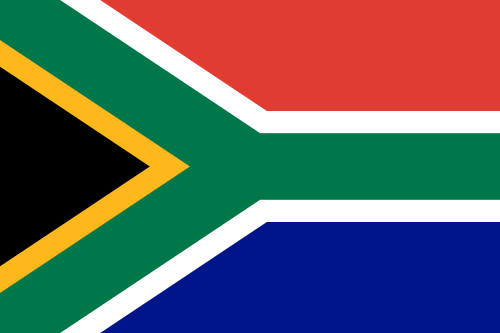
At its 1994 adoption it was the only national flag with six colors and no seal or brocade. Its sideways Y symbolizes diverse groups converging into one nation.

The green-and-gold field carries a blue celestial globe depicting the exact night sky over Rio on 15 November 1889. Each star represents a Brazilian state or the federal district.
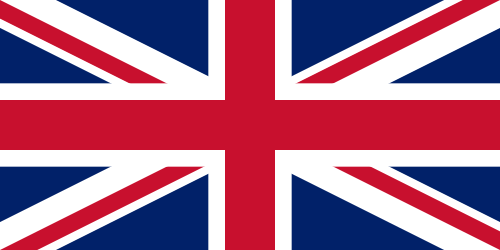
The Union Flag layers the crosses of St George, St Andrew, and St Patrick into one design. It's among the most copied flags on Earth, echoed in Australia, New Zealand, and beyond.
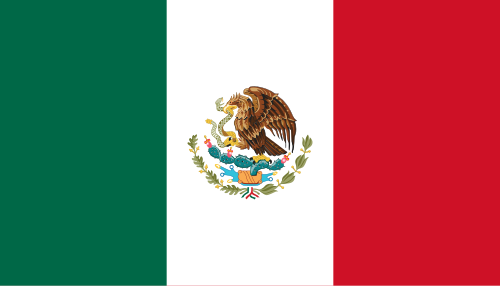
The central emblem shows a golden eagle devouring a snake atop a cactus, illustrating the Aztec legend of the founding of Tenochtitlan. Bold storytelling on a tricolor.

The blue-white-red tricolor of the Revolution became the template that dozens of nations later imitated. Historically massive, but the vertical-band format is now extremely common.

Sky-blue and white bands framing a golden Sun of May, a national emblem tied to the 1810 revolution. Distinctive palette, clean execution.
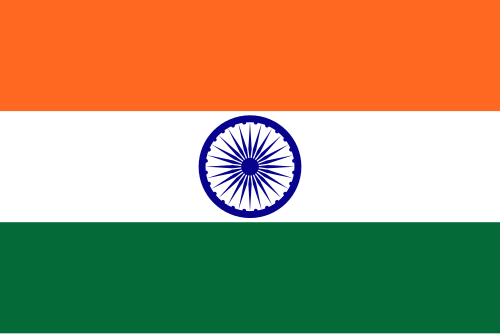
A saffron-white-green tricolor centered on the 24-spoke navy Ashoka Chakra, symbolizing law and motion. The wheel gives it identity beyond a generic band flag.

One of the few national flags featuring a dragon, the red dragon on green and white is striking and unique. It's notably absent from the Union Jack, which still stings.

Green, white, and red vertical bands inspired by the French model. Handsome but easily confused with Mexico and Ireland at a glance.
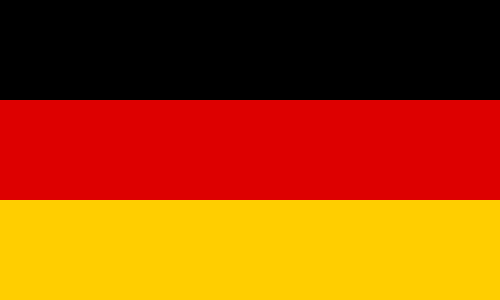
Horizontal black, red, and gold bands with 19th-century roots. Solid and historic, but it's a plain tribar with little to distinguish it visually.

A simple red-over-white bicolor that is nearly identical to Monaco's flag and an upside-down version of Poland's. Clean, but a genuine identity clash.

It depicts a literal copper-colored map of the island above olive branches, breaking the widely-cited rule that flags shouldn't be maps. It's hard to draw and reads poorly at distance.
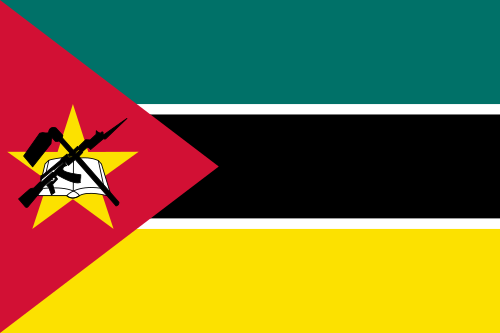
Mozambique's flag features an AK-47 with a bayonet crossed over a hoe and book, the only current national flag to depict a modern firearm. Its symbolism sparks ongoing domestic debate to replace it.
◆ Ranked on Tier Deck · browse all 296 lists · Privacy · Terms