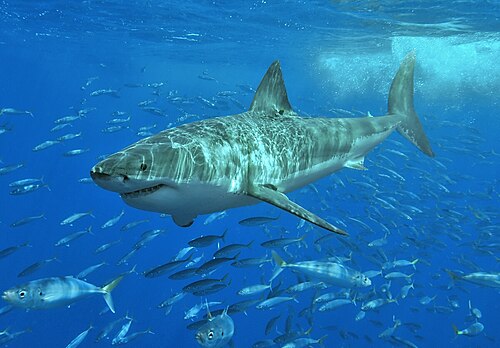
The undisputed face of sharks, reaching over 6 meters and breaching clear out of the water to ambush seals. It is the largest predatory fish alive and can detect a single drop of blood in a swimming pool's worth of water.
400 million years of evolution, finally put in their place.
The undisputed face of sharks, reaching over 6 meters and breaching clear out of the water to ambush seals. It is the largest predatory fish alive and can detect a single drop of blood in a swimming pool's worth of water.
The largest fish on Earth at up to 18 meters, yet it filter-feeds on plankton and is famously docile toward divers. Each one has a unique spot pattern like a fingerprint.
A near-perfect generalist predator that eats turtles, birds, and even license plates, second only to the great white in fatal attacks on humans. Its serrated teeth can crack a sea turtle's shell.
Its wing-shaped cephalofoil is packed with electroreceptors, letting it pin stingrays buried in the sand. The largest hammerhead species reaches about 6 meters.
The fastest shark in the ocean, clocked in bursts over 70 km/h and capable of leaping meters into the air. It is one of the few endothermic sharks, which powers its explosive bursts.
Uniquely able to thrive in fresh water, it has been found over 1,000 km up the Mississippi and thousands of km up the Amazon. Its aggression and habitat overlap with humans make it one of the most dangerous species.
Jacques Cousteau called it the most dangerous of all sharks, and it was blamed for feeding on shipwreck survivors like those of the USS Indianapolis in WWII. Once among the most abundant large animals on Earth, now critically endangered.
The second-largest fish alive, cruising with its cavernous mouth open to strain plankton from the water. Utterly harmless despite a shark-of-nightmares profile.
It uses its enormously elongated tail like a bullwhip to stun schooling fish, a hunting method unique among sharks. The tail can be as long as its entire body.
A strikingly slender, deep-blue open-ocean shark that migrates across entire oceans, tracked from New England to South America. Sadly it is the most heavily caught shark on the planet.
A slow, docile nocturnal feeder that suctions prey off the seafloor with some of the strongest suction forces of any fish, and rests motionless under ledges by day. A diver favorite for its total lack of menace.
Its permanently protruding needle teeth look terrifying, but it is placid and the only shark known to gulp air at the surface to hover neutrally buoyant. An aquarium staple.
A small, timid reef shark instantly recognizable by the black tips on its fins, common in shallow tropical lagoons. Mostly a threat to small fish, not people.
A handsome, harmless bottom-feeder patterned in dark saddles and spots, cruising shallow California bays and estuaries. Poses essentially zero danger to humans.
A quirky Australian bullhead shark with crushing molar-like teeth for grinding shellfish and blunt harness-marked markings running down its body. More novelty than nightmare.
The longest-living vertebrate known, with individuals estimated at nearly 400 years old, drifting slowly through frigid Arctic depths. Its flesh is toxic unless carefully fermented.
A cigar-sized parasite that latches onto whales, tuna, and even submarine sonar domes to carve out perfect round plugs of flesh. Gross, sneaky, and weirdly successful.
The largest shark that ever lived, likely 15 meters or more, but it went extinct roughly 3.6 million years ago, so it loses on a technicality: you cannot rank a no-show. Fuels endless fake Discovery documentaries.
◆ Ranked on Tier Deck · browse all 296 lists · Privacy · Terms