
Apollo 11
First humans on the Moon
On July 20, 1969, Neil Armstrong and Buzz Aldrin became the first people to walk on the Moon while an estimated 600 million people watched on Earth. It remains the defining achievement of human spaceflight.
The launches that made history, and the ones that made headlines
On July 20, 1969, Neil Armstrong and Buzz Aldrin became the first people to walk on the Moon while an estimated 600 million people watched on Earth. It remains the defining achievement of human spaceflight.

Launched in 1977, it toured Jupiter and Saturn and in 2012 became the first spacecraft to enter interstellar space. It is now over 25 billion km from Earth and still transmitting.

The Soviet Union's launch of the first artificial satellite on October 4, 1957 opened the Space Age and triggered the Space Race. Its simple radio beep was tracked worldwide.
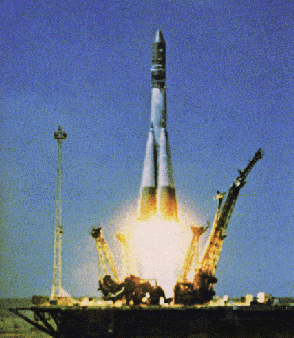
Yuri Gagarin completed a single orbit of Earth on April 12, 1961, becoming the first human to travel into space. The flight lasted 108 minutes.

Launched in 1990 and serviced by five Shuttle missions, Hubble revolutionized astronomy, refining the age of the universe and delivering the iconic Deep Field images.

It studied Saturn from 2004 to 2017 and dropped the Huygens probe onto Titan, the first landing in the outer solar system. It discovered geysers on Enceladus before its planned plunge into Saturn.

Launched December 2021 and stationed at L2, its 6.5-meter mirror sees the earliest galaxies in infrared. It has already reshaped models of early-universe galaxy formation.
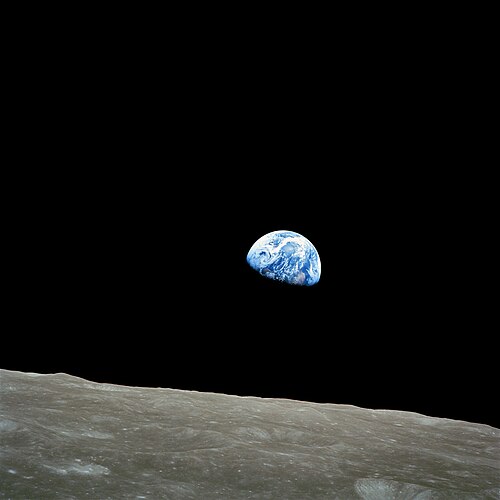
In December 1968 its crew became the first humans to leave low Earth orbit and circle the Moon, capturing the famous 'Earthrise' photograph. It proved the path to a lunar landing.

An oxygen tank exploded en route to the Moon in 1970, but NASA improvised repairs and returned all three astronauts alive. It became a landmark case study in crisis engineering.

After a 9-year, 5-billion-km journey, it flew past Pluto in July 2015, revealing its heart-shaped nitrogen glacier. It later visited Kuiper Belt object Arrokoth.

Landed in Gale Crater in 2012 via the daring 'sky crane', it confirmed the crater once held a habitable lake environment. It has driven over 30 km and is still operating.

Landed in Jezero Crater in 2021, it is collecting rock cores for a future sample-return mission and carried Ingenuity, the first aircraft to fly on another planet.
The only spacecraft ever to fly past all four outer planets, it remains the sole probe to visit Uranus (1986) and Neptune (1989). It reached interstellar space in 2018.

In 1976 it became the first spacecraft to land on Mars and operate successfully, returning the first images from the surface and running biology experiments for life.

The ESA probe orbited comet 67P from 2014 and deployed the Philae lander, the first soft landing on a comet nucleus. Philae's harpoons failed, cutting its science short.

In January 2019 China's mission became the first to soft-land on the far side of the Moon, deploying the Yutu-2 rover and relaying data via a dedicated satellite.

In 1999 the $327-million orbiter was destroyed because one team used imperial units while another used metric, sending it too low into the Martian atmosphere. It is a textbook engineering failure.
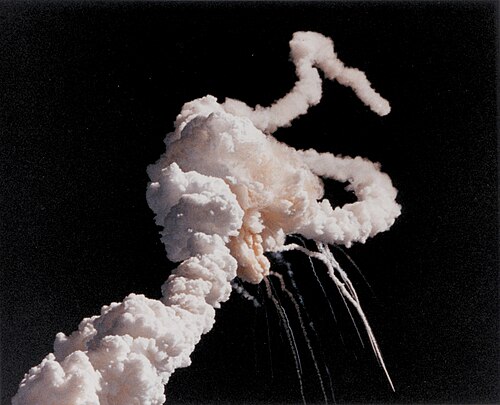
On January 28, 1986, the Space Shuttle broke apart shortly after liftoff, killing all seven crew including teacher Christa McAuliffe. An O-ring failure in cold weather, flagged and overruled, was the cause.
◆ Ranked on Tier Deck · browse all 296 lists · Privacy · Terms