← All tier lists

Volcanoes, Ranked

Earth's most magnificent ways to ruin your afternoon.

Ranked on historical impact, eruptive drama, scientific significance, and sheer iconic status — not just body count.
✦ Disagree? Make your own →
S
Mount Vesuvius
Mount Vesuvius
The one that buried Pompeii

Its 79 AD eruption buried the Roman cities of Pompeii and Herculaneum under ash and pyroclastic flows, preserving them for centuries. It remains one of the most dangerous volcanoes on Earth with roughly 3 million people living nearby.

Krakatoa
Krakatoa
The loudest sound ever heard

The 1883 eruption produced what is considered the loudest sound in recorded history, audible nearly 5,000 km away, and killed over 36,000 people mostly via tsunamis. It ejected so much ash that global temperatures dropped and sunsets turned red worldwide.

Kīlauea
Kīlauea
The one that never stops

One of the most active volcanoes on Earth, it erupted almost continuously from 1983 to 2018 and its 2018 eruption destroyed over 700 homes in Hawaii. Its accessible lava lakes have made it a cornerstone of modern volcanology.

A
Mount Fuji
Mount Fuji
Japan's sacred snow-cap

Japan's tallest peak at 3,776 m and a near-perfect stratovolcano, it is a UNESCO World Heritage Site and cultural icon depicted in countless artworks. It last erupted in 1707 but is still classified as active.

Mount St. Helens
Mount St. Helens
The mountain that blew sideways

Its May 18, 1980 eruption blasted laterally, removing about 400 m of summit and killing 57 people in the deadliest volcanic event in U.S. history. The event reshaped how scientists understand catastrophic flank collapses.

Mount Etna
Mount Etna
Europe's restless giant

The largest active volcano in Europe and one of the most active in the world, with documented eruptions going back over 2,700 years. It is a UNESCO World Heritage Site that erupts frequently yet rarely lethally.

Mount Tambora
Mount Tambora
The Year Without a Summer

Its 1815 eruption was the most powerful in recorded history (VEI 7), killing tens of thousands directly and causing the 1816 'Year Without a Summer' that brought global crop failures. It ejected so much material that it caused worldwide climate disruption.

B
Mauna Loa
Mauna Loa
The biggest of them all

Among the largest volcanoes on Earth by volume and area, rising from the Pacific seafloor to dominate the island of Hawaii. It erupted in 2022 for the first time in 38 years.

Eyjafjallajökull
Eyjafjallajökull
The one that grounded Europe

Its 2010 eruption spewed an ash cloud that closed much of European airspace for days, cancelling roughly 100,000 flights. Its unpronounceable name became a global talking point overnight.

Mount Pinatubo
Mount Pinatubo
It cooled the whole planet

Its 1991 eruption was the second-largest of the 20th century and injected enough sulfur into the stratosphere to lower global temperatures by about 0.5°C for a couple of years. Successful evacuation warnings saved thousands of lives.

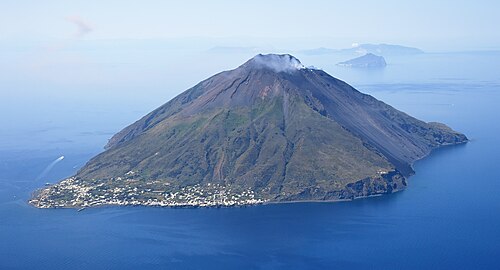
Stromboli
Stromboli
Lighthouse of the Mediterranean

It has erupted almost continuously for over 2,000 years with regular small explosions, earning its nickname as a natural beacon for sailors. Its predictable bursts give the mild 'Strombolian' eruption style its name.

Popocatépetl
Popocatépetl
The smoking mountain

An active stratovolcano whose name means 'smoking mountain' in Nahuatl, it looms about 70 km from Mexico City and its metro area of over 20 million. It frequently vents ash, prompting regular aviation and evacuation alerts.

C
Mount Rainier
Mount Rainier
America's most dangerous

Draped in more glacial ice than any other peak in the contiguous U.S., it is considered one of the most dangerous volcanoes because a modest eruption could unleash massive lahars into populated Washington valleys. It hasn't erupted significantly in over a century, keeping it more threat than spectacle.

Mount Pelée
Mount Pelée
The town-killing cloud

Its 1902 eruption unleashed a pyroclastic flow that destroyed the city of Saint-Pierre in minutes, killing about 30,000 people. The disaster gave scientists the term 'nuée ardente' for glowing avalanches of gas and ash.

Cotopaxi
Cotopaxi
The perfect glacier cone

One of the world's highest active volcanoes at 5,897 m, it is a strikingly symmetrical, glacier-capped cone in Ecuador. Its glaciers make it a serious lahar hazard, and it reawakened with unrest in 2015.

Yellowstone Caldera
Yellowstone Caldera
The supervolcano beneath the park

A supervolcano whose ancient super-eruptions blanketed much of North America in ash, it powers Yellowstone's famous geysers and hot springs today. Its doomsday reputation is real but its odds of erupting soon are extremely low.

D
Ol Doinyo Lengai
Ol Doinyo Lengai
The one with black lava

The only active volcano on Earth known to erupt natrocarbonatite lava, which is so cool and runny it flows nearly black and turns white as it weathers. Scientifically unique but obscure and rarely destructive.

Mount Erebus
Mount Erebus
Antarctica's lava lake

The southernmost active volcano on Earth, it hosts one of the world's few persistent lava lakes amid the Antarctic ice. Remote and mostly harmless to humans, its fame is more curiosity than catastrophe.

F
Nevado del Ruiz
Nevado del Ruiz
The Armero tragedy

A relatively small 1985 eruption melted its summit glaciers, sending lahars that buried the town of Armero and killed about 23,000 people. It stands as a notorious case where ignored warnings turned a minor eruption into one of the deadliest volcanic disasters ever.

Mount Nyiragongo
Mount Nyiragongo
The lava lake that floods cities

Its lava is unusually fluid and fast, and its 2002 and 2021 eruptions sent flows into the city of Goma, destroying homes and displacing hundreds of thousands. Its persistent lava lake makes it one of the deadliest and most feared volcanoes in Africa.

◆ Ranked on Tier Deck · browse all 296 lists · Privacy · Terms